Annie's Easter Symbols and Their
Meanings Page
"
--- So let no one judge you in food or in drink, or regarding a
festival or a new moon
or sabbaths, which are a shadow of things to come, but the
substance is of Christ."
~Colossians 2:16-17~
Is Easter really about cute bunnies
and colored eggs?
Is it a simple innocent holiday?
The TRUTH is so important!
Please
realize that even Satan took twisted scripture that was out of
context and
misinterpreted to justify his actions and thoughts. Many people
will try to tell you that
the egg and other Easter symbols are Christian symbols. Please do
not be deceived.
I
gathered most of this information from my Encyclopedia programs.
I believe that it is very important to know
the history behind our holidays that we observe. We need to
remember that as Christians we can share
our faith with others through our holiday pages.
You
will indeed find many pages on the Internet that tell you that a
lot of these symbols are "Christian"
in nature and can be twisted or Christian "ized" to
make them easier to pallet or understand.
Please
be wise and discerning when you read information anywhere on the
Internet. "Prove all things, Hold fast
that which is good". Don't just take my word for it check
things out and pull out your Bible and
check the Scripture references out for your selves.
We are all accountable for our own actions to the Lord.
Easter
symbols:
First let me remind you that
"Easter" in the name alone was through History
connected to a Pagan Goddess.
Easton's Bible Dictionary defines Easter this way:
originally
a Saxon word (Eostre), denoting a goddess of the Saxons, in
honour of whom sacrifices were offered
about the time of the Passover. Hence the name came to be given
to the festival of the Resurrection of Christ,
which occurred at the time of the Passover. In the early English
versions this word was frequently used as the
translation of the Greek pascha (the Passover). When the
Authorized Version (1611) was formed, the word
"passover" was used in all passages in which this word
pascha occurred, except in Acts 12:4. In the Revised
Version the proper word, "passover," is always used.
Look at this passage from Compton's Encyclopedia and you decide what the symbols really mean.
"Many Easter customs come from the Old World. The white lily, the symbol of the resurrection, is
the special Easter flower. Rabbits and colored eggs have come from pagan antiquity as symbols of
new life. Easter Monday egg rolling, a custom of European origin, has become a tradition on the
lawn of the White House in Washington, D.C.
The name Easter comes from Eostre, an ancient Anglo-Saxon goddess, originally of the dawn. In
pagan times an annual spring festival was held in her honor. Some Easter customs have come from
this and other pre-Christian spring festivals. Others come from the Passover feast of the Jews,
observed in memory of their deliverance from Egypt."
~Excerpted from Compton's Interactive Encyclopedia~How you will celebrate Easter this year?
The symbols below are connected to Christianity and Easter events. We will look at their meanings.
Most of these symbols are used only during the Easter season. The rest are part of Christian life
and worship throughout the year.
Colors and their meanings:
You
can look at
Nave's Topical Bible at what is says about colors.
White means purity.
Easton's Bible Dictionary: "A symbol of purity (2 Chr. 5:12;
Ps. 51:7; Isa. 1:18; Rev. 3:18; 7:14). Our Lord, at
his transfiguration, appeared in raiment "white as the
light" (Matt. 17:2, etc.)."
White is also the symbol of holiness:
Purple is royalty and wealth.
Royalty:
Judges 8:26
Wealth: Luke 12:19
Luxury: Revelations 17:4
Green is new life but in our era is also known to mean money or jealousy.
Psalms 92:12-15 & Jeremiah 11:16
Visit
these sites to learn more:
Colors and Worship & Colors of the Kingdom

The
crucifix and the cross are present in churches and many
homes throughout the year. A crucifix is a cross
with an image of Jesus' body hanging from it. It symbolizes the
sacrifice Jesus made by allowing Himself to be
killed. An empty cross--that is, without the figure of Christ
crucified--reminds Christians of Jesus' victory over
death and the new life and hope this victory brings to believers.
The Cross is the most common symbol
of Christianity. It represents the cross on which Jesus Christ
was crucified.
Christians believe that Jesus' Crucifixion played a central role
in redeeming humanity from its sins, and they
regard the cross as a sign of redemption. Various groups of
Christians have adopted different styles of crosses.
Roman Catholics and Protestants chiefly use the Latin cross. This
cross is a vertical post with a shorter horizontal
crosspiece above the center. Many Eastern Orthodox Churches use
the Greek cross, which has four arms of equal
length.
During
the first 300 years after Christ's death, Christians feared
persecution by the hostile Roman government
and rarely displayed the cross in public. In the 300's, the
Romans began to tolerate Christianity, and crosses
were widely displayed. During the early Middle Ages, Christian
artists made crosses as symbols of the Christian
belief in the Resurrection of Christ. Many of these crosses
portrayed the risen Christ wearing priestly clothes and
a royal crown. Later, Christians began to emphasize the
sufferings of Jesus in crucifixes. A crucifix is a cross
with an image of the dying Jesus.
Crosses
have a number of uses in Christian worship. A cross on a staff is
carried in many processions. During some
ceremonies, members of the clergy or worshipers trace the shape
of a cross with a hand or certain fingers.
Cathedrals and many churches have floor plans based on the shape
of the Latin cross.
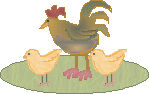
Rooster: When I traveled in Europe
for business, I noticed that the Churches didn't have crosses on
the top of
them, in the city of Amsterdam in the Netherlands. So I asked the
tour guide about it. She was very surprised
that we didn't have "roosters" on our churches in the
United States. When she started to explain it to me I
finally understood. Here is what she told me: "We have the
rooster because Peter was told by Jesus in the
Gospels in the Bible, that he would deny Christ three times. So
the rooster is to remind us not to deny Christ."
The scriptural reference to this is Matthew 26:69-75
Sunday is an Easter symbol that is also
observed the year-round. Christians traditionally worship on
Sunday
because that day is associated with the Resurrection.

Candles are burned during many
Easter celebrations, especially the vigil and midnight services
before Easter
Sunday. Christians associate Jesus with the light from candles,
calling Him "the Light of the World." Many
churches extinguish candles on their altars on Good Friday to
show that Jesus' light has gone out. In Roman
Catholic churches, the special paschal candle is lit on Easter
Sunday next to the main altar. The candle represents
Jesus' return to life. The candle is often lit during the next 40
days, until it is put out on Ascension Day.

Easter
Lilies
are
used to decorate churches and homes. The large, pure white
blossoms remind Christians of the
pure new life that comes to them through the Resurrection of
Jesus.
LILY. The white lily stands for purity.
Artists for centuries have pictured the angel Gabriel coming to
the Virgin
Mary with a spray of lilies in his hand, to announce that she is
to be the mother of the Christ child. The lily is
also the sign of the Resurrection. The lovely white Madonna lily
was used for years as the Easter lily. It often
failed to bloom in time for Easter, however, and so Bermuda
lilies were substituted. They have six-part flowers
(three petals and three sepals colored alike) and usually six
stamens.
The Lily in the BIBLE: Lessons to trust are
gathered from the Lily: Matthew 6: 28-30
Molded in the rim of the molten laver in the temple: 1 Kings 7:26
& 2 Chronicles 4:5
The principle capitals of the temple ornamented with carvings of
lilies: 1 Kings 7:19,22,26
Used in a figurative sense, of the lips of the beloved: Song of
Solomon 5:13
Related Page: Make an Easter lily - text only

Eggs and rabbits are the only
familiar symbols
unrelated to the Easter story.
Eggs, which represent new life, have been
a symbol of spring since ancient times. Christians adopted the
egg as an
Easter symbol because of the relationship between Easter and the
renewal of life. But the Pagan connection here
should not be dismissed. Ishtar was the goddess of fertility and
reproduction.

Rabbits are associated with the
fertility of spring because of their ability to produce many
young. Some parents
tell their children that the Easter Rabbit, or Easter Bunny,
brings Easter eggs.

The lamb is a particularly
important Easter symbol in central and eastern European
countries. It represents Jesus
and relates His death to that of the lamb sacrificed on the first
Passover. Christians traditionally refer to Jesus
as "the Lamb of God." Many people serve lamb as part of
the Easter feast. In many homes, a lamb-shaped cake
decorates the table. Many Eastern Orthodox Christians hang
pictures of the Easter lamb in their homes.
Other
foods.
Besides lamb and eggs, certain other foods are associated with
the Easter season. Pretzels, for
example, were originally a Lenten food. Their twisted shape
suggested arms crossed in prayer.
Hot
Cross Buns:
Hot
cross buns, now eaten throughout the Easter season, were first
baked in England to be served
on Good Friday. The buns have a cross of icing on the top. Some
people have suggested the connection to the
ancient sacramental cakes.
Hot Cross Buns - This is from a site that is
not professing Christianity. They are not a truly Christian
tradition,
even though there is a "x" or Cross on the bun. Here is
what the site says: "They are generally only served during
the Lenten season, preserving their Christian significance. Yet
they are probably the outgrowth of the ancient
pagan sacramental cakes eaten by Anglo-Saxons in honor of their
goddess "Eastore.".
Easter customs
A
number of popular customs are observed during the Easter season.
The majority of Christians follows some of
these customs. Others are observed in a particular area or by a
particular group.
Carnivals provide opportunities for
feasting and merrymaking before the solemn fast days of Lent. The
word
carnival comes from the Latin word carnelevarium, which means
removal of meat. The most famous carnival is the
Mardi Gras, celebrated on Shrove Tuesday, the day before Lent
begins. Mardi Gras is a French term that means
Fat Tuesday. It refers to the fat ox that traditionally led a
procession on Shrove Tuesday in France. Carnivals
often feature parades in which people wear elaborate costumes.
The best-known Mardi Gras parade in North
America takes place in New Orleans.
Easter
eggs.
Exchanging and eating Easter eggs is a popular custom in many
countries. In most cases, chicken eggs
are used. The eggs are hard-boiled and dyed in various colors and
patterns. Many countries have their own
traditional patterns. Probably the most famous Easter eggs are
those designed in Ukraine and Poland, where
Christians decorate the eggs with complicated red, black, and
white patterns.
In
many countries, children hunt for Easter eggs hidden about the
home. Children in the United Kingdom,
Germany, and some other countries play a game in which eggs are
rolled against one another or down a hill. The
egg that stays uncracked the longest wins. Since 1878, children
in Washington, D.C. have been invited to roll
eggs on the White House lawn.
Passion Plays dramatize the Easter
story. Such plays have been performed during the Easter season
since the
Middle Ages. The most famous one is usually presented every 10
years in Oberammergau, in southern Germany. It
dates from 1634. In the United States, Passion Plays are
performed annually in several cities.
Visit: The Black Hills Passion
Play Home Page
Feasting. Easter Sunday is a feast
day. Many Christians in Eastern Europe and those of eastern
European ancestry
in North America have their Easter feast blessed by a priest. The
priest may go to the home, or families may
take their food to church for the blessing.
Easter Bonnets

Wearing new clothes for Easter is a custom
common among many Christians. It may have originated from the old
practice of having newly baptized Christians wear new white
clothes for the Easter celebration. Like many other
Easter symbols, the new clothes represent the new life offered
through the death and Resurrection of Jesus.
Easter promenades of people in new clothes
are a tradition in many European towns and villages. A person
holding a
cross or an Easter candle leads some of these promenades. In New
York City, thousands of people stroll in the
Easter Parade down Fifth Avenue to show off their new clothes
following Easter services.

Other customs: Many communities follow
customs of the Easter season that are special to them. In
Bethlehem,
Pa., for example, a trombone choir of the Moravian Church plays
hymns throughout the city before dawn on
Easter Sunday to call church members to a sunrise service in the
old Moravian cemetery. At the cemetery, the
trombones play a joyful chorus as the sun appears on the horizon.
Easter
customs
A
number of popular customs are observed during the Easter season.
Most Christians follow some. Others are
observed in a particular area or by a particular group.
In many countries,
children hunt for Easter eggs hidden about the home. Children in
the United Kingdom,
Germany, and some other countries play a game in which eggs are
rolled against one another or down a hill. The
egg that stays uncracked the longest wins. Since 1878, children
in Washington, D.C. have been invited to roll
eggs on the White House lawn.
Information on this page from the
resources listed below:
~Excerpted
from Compton's Interactive Encyclopedia & The World Book
Encyclopedia~

Easter will be on Sunday April 24th, 2011
Related Page: Annie's Easter History Page
Annie's "Why do you have
Bunnies & Eggs on your Easter Pages? Page
Visit: Annie's Easter Page to see a listing of all my
Easter Pages
Annie's
Featured Holiday Page |
Annie's
Featured Page |
Copyright
1998 - 2011 Annie's Home Page. All Rights Reserved. I thank the
Lord for
graphics artists without them these pages would not be the same.
Please visit
Annie's List of Great Graphics Spots for a list of their links.
Some graphics on
this page from: Cute Countryside Graphics & Kim's Whim
Graphics & Ritva's Gallery
& Marsha's
Graphic Garden. Silent
No Right Click Script from Dynamic Drive.
For Instructions visit: Annie's "How to Add
Silent No Right Click Script" Page.
For a
Listing of the Rest of my Pages: