Celebrated for 8 days and begins on December 1st, 2010
~Actually begins at sunset on December 1st thru the 9th~
Annie's
Hanukkah Page
Celebrated
for 8 days and begins on December 1st, 2010
~Actually begins at sunset on
December 1st thru the 9th~
Hanukkah,
pronounced HAH nu kah, is the Jewish Feast of Lights or Feast of
Dedication. The Hebrew word
hanukkah (also written Hannuka; Hanukah or Chanukah) means
dedication. The Hanukkah holiday begins
on the eve of the 25th day of the Hebrew month of Kislev
(approximately December) and lasts eight days.
During Hanukkah, gifts are exchanged and contributions made to
the poor. On the first evening, one candle is
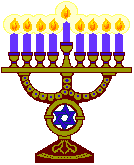
lighted in a special eight-branched candelabrum called a menorah
or hanukkiyah. Beginning on the second night,
one candle is added every night until the total reaches eight on
the last night. The candles are lighted by
a separate candle called a shamash.
The two books of Maccabees in the Apocrypha tell the story of
Hanukkah. In 165 B.C., after a three-year
struggle led by Judah Maccabee, the Jews
in Judea defeated the Syrian tyrant Antiochus IV. They held
festivities in the Temple in Jerusalem, and dedicated it to God.
According to the Talmud, written many centuries after the event,
when the Jews cleaned the Temple of Syrian
idols, they found only one small cruse of oil with which to light
their holy lamps. But miraculously, the cruse
provided them with oil for eight days. Other sources tell of a
torchlight parade in the Temple, which may also
have contributed to the tradition of lighting candles on
Hanukkah.
~Above Information from The World Book~
Judah
Maccabee
Judah Maccabee, pronounced JOO duh
MAK uh bee, was the leader of the Jews in their struggle for
independence in the 100's B.C. He was the son of a priest named
Mattathias from the ancient city of Modin.
Judah's name is also spelled Judas Maccabaeus. His family is
known as the Hasmoneans in the rabbinic texts.
Judah's story is told in the Book of 1 Maccabees in the
Apocrypha.
At that time, the Jews were subjects of the Seleucid Empire, one
of the states formed out of Alexander the
Great's empire. The Seleucid king, Antiochus IV (called
Epiphanes), wanted his subjects to adopt Greek culture
and customs. Many Jews did this, almost to the point of
abandoning their religion. But others resisted.
Antiochus also
wanted to get possession of the treasures in the Jews' Temple. In
168 or 167 B.C., angered by
Jewish resistance to his policy, he entered Jerusalem, killed
many of the people, and defiled the Temple by
building an altar to a pagan god there. This is known as the
Abomination of Desolation in the Gospels and in the
Book of Daniel. The practice of Jewish law was forbidden, and
copies of the law were destroyed. Jews who
disobeyed were killed.
War broke out when an officer of the king came to Modin and tried
to make Mattathias offer sacrifice to the
pagan god. Mattathias refused. He fled to the hills, and although
he died soon after, his son Judah took his
place. Though outnumbered, he repeatedly defeated the king's
armies. About 165 B.C., he re-entered Jerusalem
and purified and rededicated the Temple. The Jewish feast of
Hanukkah commemorates this event. Judah won
other victories, but in 160 B.C. he died in battle. His brothers,
Jonathan and Simon, carried on.
~Above Information from The World Book~
Hanukkah, or the Feast of Lights, is a celebration of
God's deliverance of the Jews in 165 B.C. That year,
the Jews won their first struggle for religious freedom by
defeating the Syrians, who wanted them to give up
Judaism. Hanukkah usually comes in December and is celebrated by
the lighting of candles in a special
Hanukkah branched candlestick called a menorah.
Hanukkah (or Chanukah), Jewish
festival. The triumph of the few over the many and the weak over
the strong,
and the faith in one miracle-making god is celebrated on the
Jewish festival of Hanukkah.
Jerusalem was ruled as part of the
Seleucid Dynasty beginning in about 198 BC . One member of the
dynasty in
particular, Antiochus Epiphanes IV, who ruled from 175 to 163 BC,
brought Greek culture to the land of Israel
and insisted that the Jews living there worship the pagan gods
idolized by the Seleucid Greeks. Mattathias, a high
priest from the village of Modi'in, led a revolt against the rule
of Antiochus. When Antiochus ordered the Jews
to make animal sacrifices and pay homage to Greek gods and pagan
idols, Mattathias refused. Antiochus
threatened those refusing to abandon their Judaism with the death
penalty, and his armies desecrated the Temple
in Jerusalem. The small army of Jews was led by Mattathias and
subsequently by his son Judas Maccabaeus, or
Judah Maccabee. The name Maccabee came from the Hebrew word for
hammer. The Maccabees regained access to
the Temple in Jerusalem after seven years of fighting. In 165 BC
the Maccabees purified and rededicated the
Temple. The festival of Hanukkah took its name from the Hebrew
word for dedication.
A later story found in the Jewish
oral law compiled in the Talmud told of a
small vial of oil found by the
Maccabees when they came into the Temple. There was enough oil to
last for only one night, but the oil
miraculously lasted for eight nights, during which time Judah
Maccabee was able to obtain fine fresh oil for the
temple lamps. Some scholars believe that this story was added to
move the focus of the story from the military
victory to the sacred realm of God and miracles. Hanukkah became
known as both the Festival of Lights and the
Festival of Dedication.
The holiday, which is not a holy day
requiring fasting or praying, has been celebrated continuously
for thousands
of years by Jews all over the world. It begins on the 25th of the
Jewish month of Kislev, which usually falls
sometime in the civil month of December, and is celebrated for
eight nights to commemorate the eight days during
which the oil lasted. The holiday involves worship that is
centered more in the home than in the synagogue. People
light candles on a menorah, or hanukkiah, adding a new candle for
each night. The menorah is an eight-branched
candelabra with a ninth holder for a helper candle called the
shamash. Since the menorah could not be used as
the only source of light, and since no candle was to light
another, the shamash was used to light each nightly
candle. Two blessings are said
each night: one is a blessing over the candles, and the other is
in remembrance of
the miracle of the oil. An extra blessing of thanksgiving is
added on the first night. The menorah is displayed
prominently in a family's window. Many of the customs and rituals
surrounding the holiday relate to oil. The foods
prepared for Hanukkah include latkes, or potato
pancakes fried in oil, and round donuts, called sufganiyot, that
are filled with jelly and fried in oil. The tradition of giving
gelt, or Hanukkah coins, to children began in Europe
in the Middle Ages. Occasionally the gelt is used to create a pot
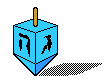
for a game of dreidel. The dreidel is a spinning
top with a different letter on each of its four sides. The
letters are the first initials of the words in the phrase
nes gadol haya sham, meaning "a great miracle happened
there." Children and parents play the game until someone
wins all of the gelt. In modern Israel the letters of the dreidel
were changed to reflect the translation "a great
miracle happened here." The dreidel is called sevivon in
Hebrew.
In contemporary Israel Hanukkah is a
national holiday, and students present plays, sing holiday songs,
and have
parties. Schools are closed, and menorahs are displayed atop such
prominent buildings as the Israeli parliament,
or Knesset. The highlight of the eight-day festival is an annual
relay race from Modi'in to Jerusalem. Runners
carry burning torches through the streets beginning in Modi'in.
The runners continue until the final torchbearer
arrives at the Western Wall, which is the last remnant of the
Temple. The torchbearer hands the torch
to the chief rabbi, who uses it to light the first candle of a
giant menorah.
In countries where Christmas rituals
are widespread, some echoes of those rituals appear in Hanukkah
celebrations.
Some families, for example, exchange gifts or decorate their
homes. The word Hanukkah in Hebrew also means
"education," and rabbis and Jewish educators try to
instill in their congregants and students the notion that the
holiday celebrates Jewish continuity. They teach that Mattathias
and his sons had stood up to their oppressors
and that modern Jews must also insist on Jewish continuity.
~From Compton's Encyclopedia~
Jewish
Hanukah Links:

Jewish Holiday Cooking:
Hanukah
The Online Menorah
The Jewish Parent Page
Judaism 101 - Chanukkah
Happy Chanukah
Jewish Cooking With Joan
Nathan
Perfect Latkes
See Chanukkah Candle Lighting Blessings for the full text of these
blessings.
Hanukkah celebration is
rich with tradition
Test your knowledge of the
month's major religious observances
How Jewish families deal
with 'the December dilemma'
Learn how to: Celebrate Hanukkah & Find Hanukkah Information Online & Make Challah
& Prepare for Hanukkah & Understand Hanukkah's Significance
& Light the Menorah from "ehow.com"
Virtual Chanukah
Hanukkah
Pages for Kids

Not Just for Kids Hanukkah
Torah Tots has some GREAT Chanukah pages:
Play Spin the Dreidel
Online
Coloring Pages
Fun & Games
About Chanuka
Kids Domain have some great Chanukah pages:
Chanukah Time at Kids Domain
Crafts & Clip Art
Online Games
Word Searches
Mazes & Icons
Coloring Pages
ALEF Land has a great Happy Chanuka!! Page to visit.
They have a Light the Menorah Game to download for FREE and
play on your computer.
Coloring Pages & Online Story
Sear's Portrait Shop Online offers: Hanukkah Latkes...Yum! & My Hanukkah Holiday for Kids to enjoy
Happy Chanukah - "The Jewish holiday
known as Chanukah, Festival of Lights, as seen through the eyes
of 6th
graders at the Ramaz Lower School in NYC."
From "ehow.com -- Learn how to: Make a Dreidel & Play the Dreidel Game & Teach Children the Meaning of
Hanukkah
Interactive Menorah
Billy Bear Hanukkah Kids
Things
More
Hanukah Pages:
Messianic
Hanukah Links: The Messianic Significance
of Hanukah
The World Book Encyclopedia has this page Hanukkah
Christmas, Hanukah, Yule,
Kwanzaa
from FabulousFoods.com
Happy Hanukkah from the 4
Seests in Paradise!!
The Tabernacle
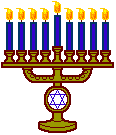
of God and The Menorah: The Holy Place could be entered by
ordinary priests.
It contained the table of the shewbread, the menorah, or
seven-branched candlestick, and an incense altar.
~From Compton's Interactive Encyclopedia~
Read the Weekly Torah Reading Online at Torah Fax in Cyberspace
The
dictionary defines:

drei•del
Pronunciation: (drAd'l),
—n.,
—pl. -dels, -del.
a four-sided top bearing the Hebrew letters nun, gimel, he, and
shin, one on each side, used chiefly in a
children's game traditionally played on the Jewish festival of
Hanukkah.
me•nor•ah
Pronunciation: (mu-nôr'u, -nOr'u),
—n.
1. a candelabrum having seven branches (as used in the Biblical
tabernacle or the Temple in Jerusalem), or any
number of branches (as used in modern synagogues).
2. a candelabrum having nine branches, for use on the Jewish
festival of Hanukkah.
Thoughts from Annie about Hanukkah:

When
I was about 6 years old we lived in the suburbs of Toronto. Our
neighborhood had a lot of Jewish families.
To a child who celebrate Christmas and only got presents that one
day, eight days of presents seemed pretty
appealing. So I came home one day from school and announced to my
parents "I want to BE Chanukah".
Of course it should be "celebrate Chanukah" and
"be Jewish", but it was a cute story nevertheless.
Generally
speaking we consider Hanukkah a Jewish holiday. But we need to
remember that Jesus was Jewish and
He did partake of the feasts and fasts mentioned in the Old
Testament. I know that it is not necessary to take
part in them to be a Christian and of course we are not bound by
the Law of the Old Testament because Jesus
fulfilled that through his death and resurrection. Some will
disagree with me but I do feel that it is important
for use to learn about the Temple and the Feasts. We can learn so
much from an extensive Bible study about
them. You might consider doing a word study on
"lampstand" and "candlestick". You can find
the word
"candlestick" 39
times
but not menorah. As I have mentioned on other pages there are 7
major feasts in the
Jewish faith. They have prophetic meaning and 4 of the 7 have
been literally fulfilled in Jesus.
What does the Bible say about
Chanukah?

Hanukkah is not mentioned in the Old Testament by name but is
mentioned in the New
Testament. The word "Chanukah" is not in the Bible by
name but we do find
"The Feast of Dedication" which is the same thing.
Torrey’s Topical Textbook - Feast of Dedication, the
Smith’s Bible
Dictionary
Dedication, Feast of the:
the
festival instituted to commemorate the purging of the temple and
the rebuilding of the altar after Judas
Maccabbeus had driven out the Syrians, B.C. 164. 1 Macc. 4:52-59.
It is named only once in the canonical
Scriptures. (John 10:22) It commenced on the 25th of Chisleu
(early in December), the anniversary of the
pollution of the temple by Antiochus Epiphanes, B.C. 167. Like
the great Mosaic feasts, it lasted eight days, but
it did not require attendance at Jerusalem. It was an occasion of
much festivity, and was celebrated in nearly the
same manner as the feast of tabernacles, with the carrying of
branches of trees and with much singing. In the
temple at Jerusalem the "Hallel" was sung every day of
the feast.
Easton’s Bible
Dictionary
Dedication, Feast of the
(John 10:22,42), i.e., the feast of the
renewing. It was instituted B.C. 164 to commemorate the purging
of the
temple after its pollution by Antiochus Epiphanes (B.C. 167), and
the rebuilding of the altar after the Syrian
invaders had been driven out by Judas Maccabaeus. It lasted for
eight days, beginning on the 25th of the month
Chisleu (December), which was often a period of heavy rains (Ezra 10:9,13). It was an occasion of
much rejoicing
and festivity.
But there were
other dedications of the temple. (1) That of Solomon's temple (1 Kings 8:2; 2 Chr 5:3); (2) the
dedication in the days of Hezekiah (2 Chronicles 29); and (3) the dedication
of the temple after the Captivity
(Ezra 6:16).
Related Pages
by Annie:
Annie's Feasts of the Bible Page
Annie's "Jesus-Messiah
the Fulfillment of Prophecy" Page
Annie's List of All Feasts of the
Bible Pages
Annie's "Jewish
Calendar Dates for 5770" Page
Annie's "2010 Holidays"
Page
Hanukkah
Cards:
Send a Hanukkah Greeting to a friend!
From Annie's Card Shop
Annie's
Featured Holiday Page |
Annie's
Featured Page |
Copyright
1999 - 2010 Annie's Home Page. All Rights Reserved
I thank the Lord for graphics artists without them these pages
would not be the same.
Please visit Annie's List of Great Graphics Spots for a list of their links.
Sources: The World Book; Bible; Torrey's Topical Textbook;
Naves Topical Bible & Compton's Encyclopedia. This site
hosted by: Christian Web Host.
Silent
No Right Click Script from Dynamic Drive. For Instructions on how
to add the no
right click script visit: Annie's "How to Add Silent No
Right Click Script" Page.
For a
Listing of the Rest of my Pages: